Wealthy Boomer Jonathan Chevreau told us that in September and October mutual fund investors in Canada withdrew huge amounts from their mutual funds while ETFs were simultaneously experiencing large net purchases, notably of iShares broad-based S&P TSX60 Canadian Market Index (symbol XIU).
The iShares Canada press release touting these results also mentions the same thing happening in the USA: "As of July, the United States saw ETF inflows at US$41 billion as compared to US mutual fund outflows of US$47
billion.", citing its source as Investment Company Institute, August 2008.
It is interesting to speculate whether this is actual switching from mutual funds to ETFs in a kind of deathbed conversion or if it is simply symptomatic of two groups of investors with different mindsets and reactions to the market woes, i.e. the mutual fund sellers think the market decline is the end of the world while the ETF buyers see it as a buying opportunity for the long term. I vote for the latter interpretation.
Tuesday, 11 November 2008


Friday, 7 November 2008
Credit Crunch? Depends How You Look At It
An interesting direct mail advertising offer popped into our mailbox a few days ago. Provident Personal Credit is actively offering cash loans from £500 to £500. Huh? Everything one reads these days about credit is that no one can get a loan, even the most creditworthy. But Provident is gung ho seeking clients, even if "you have been turned down before, you have a poor credit history, you're not working at the moment"!
How can they do this successfully? As their flyer says, "We'll base your loan on your circumstances and how much you can afford to repay." The parent company Provident Financial's Interim Management Statement of October 22nd gives further clues to a tightly run operation:
There is none of the sub-prime mortgage loan nonsense of agents paid for originating loans that were then sold off in parcels to other banks far away who had no clue of loan quality or contact with the debtors.
And the results bear out the accuracy of management's words. The July 30th, 2008 Interim Results showed a 34% increase in Profits before tax and a 28% rise in earnings per share, with loans and customers also growing. The company is hiring too as these ads on MyJobSearch.com show, another sign of continued growth. No credit crunch here it seems.
Management's forecast is quite positive: "... Our conservative approach to lending, combined with the group's strong balance sheet and funding profile, means the group is well placed to continue to generate high quality customer and profits growth."
The share price (PFG on London Stock Exchange) is down only 3.8% over 1 year, a darn sight better than the minus 33.5% for the FTSE All-Share. Thanks to Google Finance for the graph below.

What's the catch? Depends on your viewpoint perhaps but the 183.2% typical APR interest rate exceeds the bounds of reasonableness. The rate is plainly and prominently visible on the ad and on the website home page, so no one can complain they don't know what they are signing up for. And considering that clients are often those who cannot qualify for, and do not have, loans elsewhere, maybe there is some value to those who borrow from Provident. Still, 183.2%!!!
The downside for borrowers is the familiar debt trap, where people get in and cannot get out, as this one tale from a Provident customer demonstrates with an interesting response from a Provident agent. Crunched by credit indeed.
How can they do this successfully? As their flyer says, "We'll base your loan on your circumstances and how much you can afford to repay." The parent company Provident Financial's Interim Management Statement of October 22nd gives further clues to a tightly run operation:
"... all loans are underwritten face-to-face in the home, which provides a sharp assessment of each customer's character and current circumstances. Home credit loans are for small sums repayable over a short period of typically a year and agents visit each customer on a weekly basis to collect the repayments, thereby continually updating their view of customers' circumstances. Not only are customers and their circumstances well understood, but since agents are paid commissions based upon collections rather than on the credit issued, there is no incentive to extend credit that the customer is unable to afford."
There is none of the sub-prime mortgage loan nonsense of agents paid for originating loans that were then sold off in parcels to other banks far away who had no clue of loan quality or contact with the debtors.
And the results bear out the accuracy of management's words. The July 30th, 2008 Interim Results showed a 34% increase in Profits before tax and a 28% rise in earnings per share, with loans and customers also growing. The company is hiring too as these ads on MyJobSearch.com show, another sign of continued growth. No credit crunch here it seems.
Management's forecast is quite positive: "... Our conservative approach to lending, combined with the group's strong balance sheet and funding profile, means the group is well placed to continue to generate high quality customer and profits growth."
The share price (PFG on London Stock Exchange) is down only 3.8% over 1 year, a darn sight better than the minus 33.5% for the FTSE All-Share. Thanks to Google Finance for the graph below.

What's the catch? Depends on your viewpoint perhaps but the 183.2% typical APR interest rate exceeds the bounds of reasonableness. The rate is plainly and prominently visible on the ad and on the website home page, so no one can complain they don't know what they are signing up for. And considering that clients are often those who cannot qualify for, and do not have, loans elsewhere, maybe there is some value to those who borrow from Provident. Still, 183.2%!!!
The downside for borrowers is the familiar debt trap, where people get in and cannot get out, as this one tale from a Provident customer demonstrates with an interesting response from a Provident agent. Crunched by credit indeed.
TD Visa Makes No Promise to Refund Zoom Tickets
When discount air carrier Zoom Airlines went out of business August 28th, some credit card companies like MasterCard and American Express were quick to issue public statements that they would refund amounts for tickets bought with their credit card. The Canadian Transportation Agency post of Oct.24th also lists some travel operators who made promises to refund.
Visa issued no such statement but I assumed that Visa would merely follow suit. It appears now that Visa's policy is different. Having applied in writing to TD Visa with all the necessary documentation within days of Zoom's demise, I have received a partial refund in mid-October. In a phone call with TD Visa's disputes department the other day to ask about the remainder, I was told by a certain "Andrea" (why does no one at these customer service lines ever have a last name?) that Visa does not promise to refund me, it only undertakes to request a refund from Zoom's bank on my behalf as a secured creditor. That has two consequences: if the collateral assets are insufficient, there won't be a full refund and; it will take a lot longer to get the money back since Visa waits till it receives funds from the bankruptcy, which can take a long time. For a card that presents itself as a premium travel card, that pretty pathetic on TD Visa's part. Beware folks, as is too often the case, the fine print and the company's behaviour don't live up to the marketing hype. It's time to look for another credit card.
In the UK, there is a useful discussion on MoneySavingExpert of experiences with various credit and debit card providers in making Zoom refunds.
Visa issued no such statement but I assumed that Visa would merely follow suit. It appears now that Visa's policy is different. Having applied in writing to TD Visa with all the necessary documentation within days of Zoom's demise, I have received a partial refund in mid-October. In a phone call with TD Visa's disputes department the other day to ask about the remainder, I was told by a certain "Andrea" (why does no one at these customer service lines ever have a last name?) that Visa does not promise to refund me, it only undertakes to request a refund from Zoom's bank on my behalf as a secured creditor. That has two consequences: if the collateral assets are insufficient, there won't be a full refund and; it will take a lot longer to get the money back since Visa waits till it receives funds from the bankruptcy, which can take a long time. For a card that presents itself as a premium travel card, that pretty pathetic on TD Visa's part. Beware folks, as is too often the case, the fine print and the company's behaviour don't live up to the marketing hype. It's time to look for another credit card.
In the UK, there is a useful discussion on MoneySavingExpert of experiences with various credit and debit card providers in making Zoom refunds.
Tuesday, 4 November 2008
Signs that the Market Panic is Over
In the month of October 2008 financial markets struck real terror into just about everyone. The panic phase now appears to be over, replaced by mere worry about the severity and length of the recession. Here are some signs of the change in mindset:
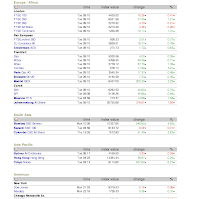
- stock markets seem to have stopped huge 10+% day to day to day swings upwards and downwards
- perfect correlation of markets has stopped, where everything is either green/up or red/down, in other words investors are beginning to look at the differential prospects of stocks ... the holdings in my portfolio with various asset classes has a comforting mix of ups and downs - diversification is beginning to work again

- politicians have gone from saying that we are all in this together to blaming each other for the mess
- the tone and body language of hosts/presenters on Bloomberg TV has shifted from end-of-the-world history-in-the-making to normal blasé cool just-another-recession
- mainstream media is doing the customary never-let-it-happen-again analysis of the mistakes that led to the crisis, e.g. CBS' 60 minutes on Credit Default Swaps.
- rich investors are still talking about opportunity or even recovery - see Steve Forbes interviewed October 25th on BBC, Warren Buffett's opinion on October 16th in the NY Times, one of the few with a positive view at that date
Monday, 3 November 2008
Financial Education in Kind at LTS Scotland
Learning and Teaching Scotland is the organization whose aim is to prepare young people for life in the modern world through the creation of programs and teaching material for schools, including those that develop financial capability.
Here is lesson 1. Dangers of online impersonation and scams. Instead of http://www.ltscotland.org.uk/, the correct URL for LTS Scotland, type in http://www.ltsscotland.org.uk/. Note the extra "s". You are brought to an ad page which offers online degree programs. I especially love the one at the bottom of the screenshot below for Ashwood University where you can obtain a PhD in only 7 days with "no studying required", a delicously ironic case in point of the need for programs in financial education.

Here is lesson 1. Dangers of online impersonation and scams. Instead of http://www.ltscotland.org.uk/, the correct URL for LTS Scotland, type in http://www.ltsscotland.org.uk/. Note the extra "s". You are brought to an ad page which offers online degree programs. I especially love the one at the bottom of the screenshot below for Ashwood University where you can obtain a PhD in only 7 days with "no studying required", a delicously ironic case in point of the need for programs in financial education.

Sunday, 2 November 2008
Dial 311 for Liquidity (In)Security
Investors worry about insufficient liquidity of their investments. Airports worry about too much liquidity. Anyone who travels by air has encountered and probably been frustrated by the liquid carry-on restrictions introduced in 2006. 3-1-1 is the catchy name that sounds like a phone number but is actually the carry-on limit for air passengers as devised in the USA and implemented worldwide. The 3 stands for the maximum of 3 ounces of liquid (or anything that is remotely like liquid). That is 3 ounces except in countries using the metric system where it is 100 ml or 3.4 ounces. Do metric bombs need more explosive to work?
The 1-1 part of the formula refers to 1 zip lock bag and 1 carry-on case/handbag etc.
For those who like to understand and delve a bit deeper into the liquids issue and airport security in general, check out the official US government website of the agency in charge the Transportation Security Administration. The TSA also runs its official blog called Evolution of Security, which is rather more interesting since it allows people to take potshots at their policies. It seems that is just a ploy to find the weak points in their systems, which is actually a smart thing to do. The TSA calls this facilitating an on-going dialogue.
Renowned security specialist Bruce Schneier publishes his comments on his excellent blog (see the Oct.29, 2008 post titled TSA news with links to a hilarious Atlantic Monthly article describing his all-too-easy circumvention of airport security rules). Scheier's blog is also good for issues of identity theft.
A bit of good news is that the TSA plans to start relaxing liquid restrictions in the fall of 2009 when it begins deploying technology that can distinguish water from explosives.
BTW, is there some secret agreement or pact of honour between western governments and terrorists that only airports and airlines should be targets of attacks? Any crowded shopping district street or mall contains far more people than does any airplane.
The 1-1 part of the formula refers to 1 zip lock bag and 1 carry-on case/handbag etc.
For those who like to understand and delve a bit deeper into the liquids issue and airport security in general, check out the official US government website of the agency in charge the Transportation Security Administration. The TSA also runs its official blog called Evolution of Security, which is rather more interesting since it allows people to take potshots at their policies. It seems that is just a ploy to find the weak points in their systems, which is actually a smart thing to do. The TSA calls this facilitating an on-going dialogue.
Renowned security specialist Bruce Schneier publishes his comments on his excellent blog (see the Oct.29, 2008 post titled TSA news with links to a hilarious Atlantic Monthly article describing his all-too-easy circumvention of airport security rules). Scheier's blog is also good for issues of identity theft.
A bit of good news is that the TSA plans to start relaxing liquid restrictions in the fall of 2009 when it begins deploying technology that can distinguish water from explosives.
BTW, is there some secret agreement or pact of honour between western governments and terrorists that only airports and airlines should be targets of attacks? Any crowded shopping district street or mall contains far more people than does any airplane.
Saturday, 1 November 2008
Junk Mail, Telephone Advertising Calls and Privacy in the UK
Worthy of note:
IT Security Expert published an excellent article Why UK Privacy is Dead on the dangers of identity theft and the lack of privacy in the UK, whose risks are unintentionally heightened by such lists as the online electoral register. He includes links and telephone numbers for getting oneself removed from the lists of direct mail advertisers aka unsolicited junk mail and similar phone calls. Both take requests for removal online or by phone.
While unwanted mail and phone calls are annoying and time wasting, the criminal use of personal details to effect fraud through social engineering is far more damaging when it happens. The Electoral list, BT Phone Book and online job search websites can all be leveraged by fraudsters. One must consider the benefits and the risks of providing one's data or allowing it to remain public. Unfortunately, as IT security Expert notes, the default is that an individual's data is published and available unless it suits the commercial or organizational interest of the body that has collected the data.
IT Security Expert published an excellent article Why UK Privacy is Dead on the dangers of identity theft and the lack of privacy in the UK, whose risks are unintentionally heightened by such lists as the online electoral register. He includes links and telephone numbers for getting oneself removed from the lists of direct mail advertisers aka unsolicited junk mail and similar phone calls. Both take requests for removal online or by phone.
- Mail - go to Mailing Preference Service
- Phone calls - go to Telephone Preference Service
While unwanted mail and phone calls are annoying and time wasting, the criminal use of personal details to effect fraud through social engineering is far more damaging when it happens. The Electoral list, BT Phone Book and online job search websites can all be leveraged by fraudsters. One must consider the benefits and the risks of providing one's data or allowing it to remain public. Unfortunately, as IT security Expert notes, the default is that an individual's data is published and available unless it suits the commercial or organizational interest of the body that has collected the data.
Subscribe to:
Posts (Atom)


 Stumble It!